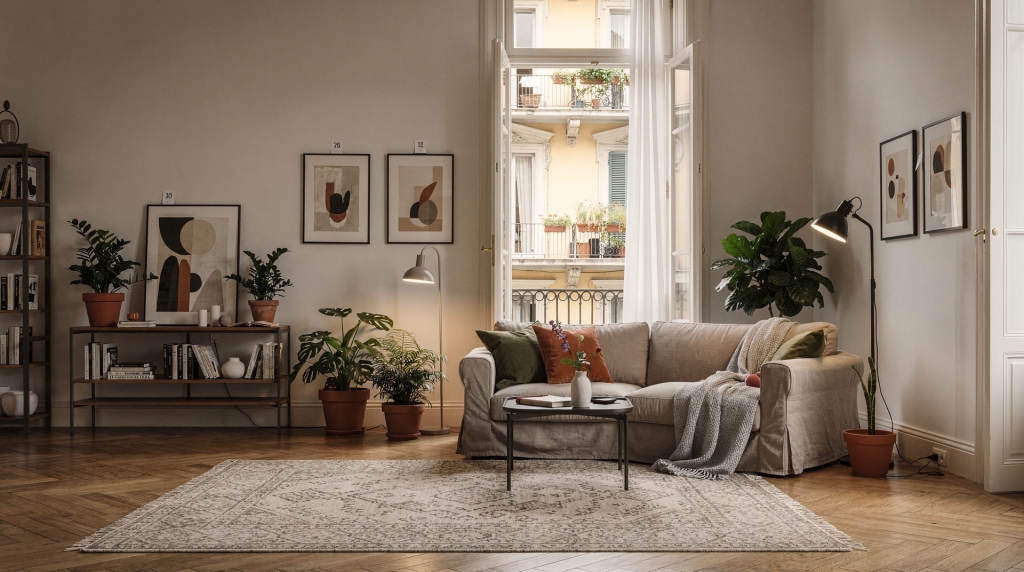
A rented apartment doesn’t have to read as temporary. In Milan, where many flats arrive furnished, compact, and layered with the visual tension between old building bones and newer insertions, the most effective transformations come from what you can layer, move, and remove — not from what you can build. Light, texture, color, and furniture placement do the heavy lifting. The goal is straightforward: make the space feel composed and personal, improve how it functions day to day, and leave no trace when the lease ends.
I approach a rental the way I’d approach a set: the architecture is the given light and proportion, and everything I bring in is a styling decision that must earn its place. The constraint of reversibility often pushes solutions toward more intelligent, less cluttered results.
What “no permanent changes” really means
In practice, this means avoiding anything that alters the property in a lasting way: drilling into walls, repainting without written consent, swapping fixed finishes, or attaching elements that damage plaster, tile, or wood. In many Italian rental contracts, even small holes for picture hooks can be restricted, and unauthorized cosmetic work can forfeit the deposit. The first step is always to read the lease carefully and ask the landlord before doing anything irreversible.
From a visual standpoint, “no permanent changes” forces a discipline I’ve come to appreciate. It shifts the focus from renovation to composition — how objects relate to each other, how textiles absorb or reflect light, how a lamp can redraw the perceived boundaries of a room. A good rented-apartment setup has three qualities:
- It can be removed cleanly, without evidence.
- It improves comfort, storage, or atmosphere — preferably all three.
- It doesn’t depend on expensive custom work that can’t travel with you.
Start with the contract and the condition of the flat
Before buying a single lamp or rug, read the lease and document the apartment exactly as it is. This matters especially in Milan, where flats often come partly furnished, recently renovated, or with original finishes — parquet, old tiles, shutters — that need to be preserved. The existing condition is your baseline; everything you add should sit lightly on top of it.
Your first checklist
- Photograph walls, floors, windows, radiators, doors, and every piece of existing furniture. Capture corners and details, not just wide shots.
- Save screenshots of the listing photos if they show the original condition — these can be invaluable later.
- Note chips, stains, loose hardware, and worn surfaces. Be specific.
- Ask the landlord what is explicitly allowed: hooks, adhesive strips, freestanding shelf units, curtain changes, painting.
- Keep written approval for any exception, even a verbal yes.
This isn’t bureaucracy for its own sake. It protects the deposit and removes ambiguity when you move out. But it also gives you a clear picture of what you’re working with — the fixed palette, the textures, the way light falls across imperfect surfaces. That knowledge shapes every subsequent choice.
The best non-permanent changes for a rented apartment
The most effective updates come from layering, not altering. Think of the room as a composition in three dimensions: what you add should be movable, reversible, and visually coherent with the bones of the space. Here’s where to focus.
1. Use textiles to change the mood fast
Textiles are the quickest way to soften a rental and make it feel intentional. They absorb sound, diffuse light, and introduce color and texture without touching the structure. In Milan apartments, where daylight can shift dramatically across the day — cool and clear in the morning, warmer and more directional by afternoon — textiles read differently as the light changes. A linen curtain that feels airy at noon can turn luminous and soft by evening.
Good options:
- Rugs to define zones and cover tired flooring. A single rug large enough to anchor the main seating area makes a room feel larger and more resolved; several small rugs tend to fragment the space visually.
- Curtains or linen panels to soften window openings and control privacy.
- Cushion covers to shift color accents without replacing furniture.
- Throws to add warmth and a sense of layered texture.
- Tablecloths or runners to give a dining corner presence.
When I look at a room, I read textiles as the soft counterpoint to hard surfaces — floors, walls, furniture frames. Getting that balance right is often what makes a space feel finished rather than bare.
2. Build atmosphere with portable lighting
Lighting is one of the most powerful reversible tools you have. Milan apartments frequently rely on a single overhead fixture — practical but rarely flattering, and it flattens the room by eliminating shadow. Adding table lamps, floor lamps, and clip lights creates layers of illumination that give the space depth and dimension.
I use a simple rule:
- One ambient light to wash the whole room.
- One task light for reading, working, or cooking.
- One accent light to create warmth and draw the eye to a corner or surface.
Warm bulbs (2700K–3000K) usually work better for living spaces because they soften harder materials — tile, stone, metal — and help the room feel calmer in the evening. If the apartment has dark corners, placing a lamp near a wall can visually expand the room by pushing light into the periphery. This is a trick I learned on set: you don’t always need to light the subject; sometimes lighting the background creates more space.
3. Choose freestanding storage instead of built-ins
When you can’t drill or renovate, furniture must carry the storage load. Freestanding shelving, open carts, sideboards, and wardrobes solve organization without touching the walls. The visual trick is to avoid overfilling every shelf — leave breathing room so the flat doesn’t feel compressed.
Look for:
- Slim shelves for tight entrances and hallways.
- Open units for books and daily objects that you want to see and access.
- Closed storage for visual calm — things you need but don’t need to display.
- Low cabinets that double as display surfaces, anchoring a wall without dominating it.
The balance between open and closed storage matters. Too much open shelving reads as visual noise; too much closed storage can feel heavy and ungenerous. The right mix depends on the room’s proportions and how much daylight it receives.
4. Use removable wall solutions
If the lease allows, damage-free hanging systems work for lighter objects — frames, mirrors, small shelves, kitchen tools — but they must be matched to the wall type. In older Milan buildings, wall surfaces can be uneven, porous, or fragile. A product that claims to be removable might still lift paint or plaster if the substrate isn’t sound.
Safer choices include:
- Adhesive hooks and strips for very light frames, tested first in a hidden spot.
- Poster rails or clip hangers that don’t require adhesive on the wall itself.
- Leaning mirrors instead of wall-mounted ones — they also add a more casual, composed feel.
- Command-style solutions rated for the weight and surface.
Avoid using adhesive systems on fragile, dusty, or peeling walls. The finish may come off when removed, and that’s exactly the kind of damage that eats into a deposit. Test carefully on an inconspicuous area and wait a day before committing.
5. Add movable decor that does real work
Objects shouldn’t only “decorate”; they should improve how the room functions. A tray organizes a coffee table and gives a loose grouping of items a visual boundary. A basket hides cables or blankets while adding natural texture. A bench near the entry holds bags and creates a landing spot. A portable mirror bounces light into a dark hallway and makes it feel less like a corridor.
Good decorative objects for rentals:
- Trays — they create order on any horizontal surface.
- Baskets — texture plus hidden storage.
- Mirrors — light and perceived space.
- Ceramic lamps — warmth and material contrast.
- Vases — a single sculptural piece can hold a wall visually.
- Stackable boxes — flexible, movable storage.
- Foldable stools — extra seating that disappears when not needed.
- Portable coat racks — no drilling, full function.
Every object should justify its presence by doing something useful or by anchoring a visual moment. If it does neither, it’s probably clutter.
What works especially well in Milan rentals
Milan apartments often arrive with inherent character: high ceilings, original parquet or tile floors, shutters, deep window reveals, architectural details that carry the weight of the building’s history. The smartest approach is usually restraint — not fighting the base, but highlighting it. You’re not starting from a blank white box; you’re working with a space that already has a visual language.
Best moves for Milan homes
- Respect existing parquet or tile with a rug that complements the floor’s tone rather than competing with it. Let the original material read through at the edges.
- Echo the architecture with simple, solid forms — furniture with clean lines that doesn’t try to out-shout the room’s proportions.
- Use fewer but better pieces. One well-placed chair with presence does more than three forgettable ones.
- Let daylight stay visible and uncluttered. Don’t block windows with heavy furniture or dense layering.
- Mix modern portable furniture with the apartment’s original details. The contrast between old and new is often where the visual interest lives.
If the flat has strong daylight, light-colored textiles and matte surfaces tend to photograph better and feel less heavy. If the apartment is darker or faces an inner courtyard — a common Milan condition — a warmer palette and reflective accents (a mirror, a glazed ceramic lamp, a metallic tray) can lift the light without looking shiny or forced.
Room-by-room approach
Living room
The living room should feel layered, not crowded. Start with a rug large enough to connect the seating pieces — this anchors the zone and gives the eye a resting place. Place a floor lamp near the seating to create a pool of light that defines the area in the evening. Use one large artwork or a considered group of light frames; a single strong piece often reads better than a scattered gallery wall. Style the coffee table with only a few objects — a tray, a book, a small ceramic piece — so the surface breathes. If the layout allows, pull furniture away from the walls. Even 20 centimeters of space behind a sofa changes how the room feels, giving it a sense of depth rather than pushing everything to the perimeter.
Bedroom
The bedroom benefits from softness and visual quiet. Layer bedding — a textured throw, linen sheets, a folded blanket at the foot — to create a sense of depth without adding furniture. If allowed, add blackout curtains; they improve sleep and also give the window a more finished presence. Place bedside lamps instead of relying only on overhead light; asymmetry here can work well if the room is small. Keep surfaces clear except for a few useful objects: a lamp, a book, a carafe. The goal is a room that feels calm the moment you enter.
Kitchen
Most rented kitchens look better when visual noise is reduced. Store small appliances out of sight when possible — behind closed doors or in a basket on a low shelf. Use matching jars or trays for dry goods to create a sense of order on open shelving. If the floor is plain and tired, a washable runner adds color and softness underfoot without commitment. Use hooks or rails only if the wall finish permits it and you’ve tested the surface; a fallen rail takes plaster with it.
Entryway
The entry is often the most neglected zone, yet it sets the tone for the entire apartment. Add a narrow console or shelf — even a slim wall-mounted piece if adhesive solutions allow — to create a landing spot. Use a tray for keys and small items; it contains the clutter and makes it look intentional. Place a mirror to bounce light and give the space a moment of expansion. Create a designated spot for shoes, bags, and coats — a bench, a basket, a portable rack — so the entry doesn’t become a dumping ground.
A practical order of operations
If the apartment feels empty or awkward, work in this sequence. The order matters because light and layout affect every choice that follows. Buying accessories before solving circulation usually leads to a flat that still feels wrong, just with more objects in it.
- Clear clutter and remove anything unnecessary. Start with a clean visual field.
- Measure the room and identify traffic paths. Understand how you move through the space.
- Decide where the main function of each area lives — seating, dining, working.
- Add lighting first. Light reshapes the room before anything else enters.
- Add textiles second. Rugs and curtains anchor zones and soften surfaces.
- Add storage third. Freestanding pieces that solve real needs.
- Finish with art, mirrors, and objects. These are the final layer, not the starting point.
Common mistakes to avoid
Too many small items
Small rentals often become visually chaotic when every surface is filled with little things. Fewer, larger pieces usually look calmer and more considered. A single substantial vase on a sideboard reads better than five small ones. This is a principle I’ve carried from styling: one strong element creates focus; many weak ones create noise.
Ignoring the existing architecture
Don’t force a style that clashes with the apartment’s bones. A Milan flat with historic details — original terrazzo, ceiling moldings, old shutters — often looks best with quiet, contemporary additions that let the architecture speak. Too many competing motifs create visual friction rather than harmony.
Choosing decor before solving function
If there’s no storage, no reading light, and no place to drop bags, the apartment will still feel unfinished no matter how styled it is. Function is the skeleton; decor is the skin. Get the skeleton right first.
Using permanent-looking solutions that are not truly removable
Some “temporary” products leave residue or lift paint on removal. Always test first in a hidden area and keep packaging information if the product claims to be removable. In older buildings, assume the wall surface is more fragile than it looks.
Overdecorating a furnished rental
If the flat already comes with strong furniture — a bold sofa, a particular dining set — add only what improves balance. Too many extra pieces can make the room feel like a showroom rather than a home. The goal is composition, not accumulation.
Quick comparison: what to use, what to avoid
| Goal | Good choice | Avoid |
|---|---|---|
| Add warmth | Rug, throw, curtains | Heavy fixed renovation |
| Improve lighting | Floor lamp, table lamp | Relying only on ceiling light |
| Create storage | Freestanding shelves, baskets | Built-ins without permission |
| Hang decor | Damage-free hooks, leaning frames | Drilling into walls |
| Personalize quickly | Books, objects, textiles | Overcrowding surfaces |
| Protect deposit | Reversible updates | Permanent alterations |
Before you move anything, ask these questions
- Can this be removed in one piece, without tools?
- Will it leave marks on paint, tile, wood, or plaster?
- Does it solve a real problem in the room?
- Does it work with the apartment’s existing light and proportions?
- Will it still look good if I remove half of it?
If the answer to the first two questions is no, it’s probably not a good rental solution. The last question is a styling check: good compositions often hold up even when you strip them back.
Simple styling formula for a better rental
When you don’t know where to start, use this formula:
- 1 rug
- 2 lamps
- 3 textile layers
- 4 storage solutions
- 5 meaningful objects
That’s usually enough to make a flat feel composed without making it heavy. The numbers aren’t rigid, but the principle holds: start with the largest anchoring pieces and layer outward.
When it is worth asking for permission
Some changes are still possible in a rental if the landlord agrees. It’s always better to get consent in writing before doing anything beyond light styling. That includes:
- Painting walls
- Replacing fixtures
- Hanging heavier items
- Altering curtain rods
- Adjusting shelving
- Changing flooring or applying adhesive coverings
In Milan, where many homes are managed carefully and some furnishings are part of the rental package, clear communication prevents disputes at the end of the lease. A written agreement protects both sides and often opens doors to solutions you might assume are off-limits.
Final checklist
- Read the lease.
- Photograph the flat on day one — every surface, every angle.
- Solve lighting first.
- Add rugs and textiles.
- Use freestanding furniture before wall fixes.
- Keep wall changes removable and tested.
- Save every receipt and product label.
- Recheck everything before checkout.
FAQ
Can you decorate a rented apartment without drilling holes?
Yes. The most effective tools are rugs, lamps, freestanding furniture, leaning mirrors, baskets, and — where the wall surface allows — removable hanging systems. The key is to think in layers: soft textiles, portable light, and movable storage do the heavy lifting without touching the structure.
What is the safest way to personalize a rental in Milan?
Start with textiles, portable lighting, and storage furniture. These changes are effective, reversible, and easy to remove at the end of the lease. In Milan apartments, where architectural character is often already present, these additions work with the space rather than against it.
Can you paint a rented apartment in Italy?
Only if the landlord agrees in writing. Painting is usually treated as a change that should be approved in advance and may need to be reversed at move-out. Never assume it’s allowed, even if the current color feels neutral or worn.
How do you make a furnished rental feel like home?
Reduce visual clutter, improve lighting with layered sources, add a cohesive textile palette, and introduce a few personal objects rather than many small accessories. The goal is to create a sense of intention — a space that feels composed, not just filled.
What should you do before using adhesive hooks?
Check the wall finish carefully. Test the product in a hidden spot and wait a day before hanging anything. Fragile, porous, or peeling walls can be damaged on removal, especially in older buildings where plaster may be unstable. When in doubt, choose a leaning or freestanding alternative.
How can a small Milan apartment look better fast?
Use one larger rug to anchor the main zone, one or two well-placed lamps to create depth, a calm palette to unify the space, and closed storage to contain visual noise. These changes usually deliver the biggest impact with the least effort — and they all reverse cleanly.