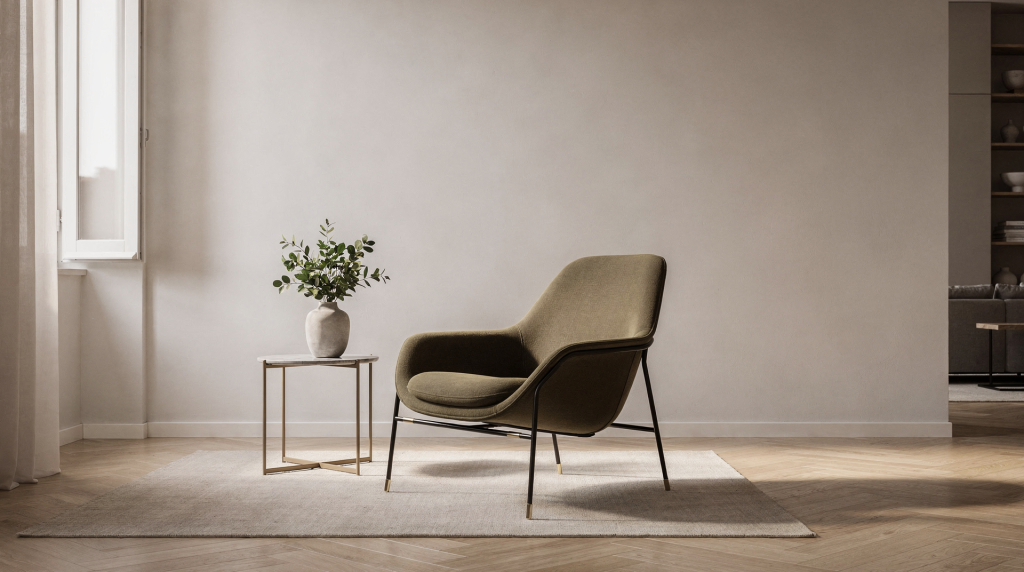
A single chair can anchor a room more decisively than a sofa, a rug, or even a large artwork when it has the right visual presence. In Milan apartments, where natural light, compact footprints, and clean architectural lines often carry much of the aesthetic weight, one well-styled chair can create the kind of visual pause that gives an entire room its structure.
Why a chair works as the focal point
A chair occupies a useful middle ground: it is small enough to read as deliberate, but large enough to hold visual weight. Unlike a sofa, it can be treated almost like a sculptural object—turned at an angle, given breathing room, or paired with a lamp, side table, or artwork to form a complete scene. As an art director, I often think of it as the hero piece in a still life: the object that gives the eye a place to rest and a reason to move through the space.
This approach works especially well in Milan homes, where many interiors rely on:
- strong daylight from tall windows or dual-aspect rooms
- restrained wall color and simple finishes
- a mix of older residential architecture and contemporary furniture
- a need to make smaller rooms feel edited rather than crowded
When a room feels flat, a chair can introduce shape, contrast, and direction without requiring a full redesign. The visual hierarchy often emerges almost automatically once the chair is placed correctly.
What makes a chair look like the main character
Not every chair can lead a room. The strongest focal chairs usually have at least one of these qualities—presence comes from contrast with the surroundings as much as from the object itself.
| Quality | What it does in the room | Best use |
|---|---|---|
| Bold silhouette | Creates instant visual recognition | Minimal interiors |
| Contrasting color | Pulls attention from neutral surroundings | Calm rooms needing energy |
| Distinct material | Adds texture and depth | Rooms with hard surfaces |
| Historic or design-led shape | Adds character and authority | Milan apartments with classic bones |
| Oversized scale | Feels deliberate and grounded | Larger living rooms |
| Strong upholstery | Catches the eye under daylight | Rooms with simple palettes |
A chair becomes the focus when it looks chosen, not leftover. It should feel different enough from the surrounding furniture to stand out, but still speak the same visual language—same color temperature, same era, or same material logic. In practice, that might mean a curved bouclé armchair in a room of straight-lined wooden pieces, or a lacquered chair against a matte plaster wall.
Step 1: Decide what role the chair should play
Before placing anything, define the chair’s job. A focal chair can do one of three things:
- Hold the center of attention: the room is built around it.
- Support the main focal point: it points toward art, a window, or a fireplace.
- Create a secondary focal corner: it gives a quiet room a destination.
In a Milan apartment, the most effective choice often depends on light. If the room gets strong daylight, the chair can live near the window and catch that light. If the room is darker, it may need to sit where the eye naturally lands from the entrance. This is not just about brightness; it is about where the eye travels first when you enter the room.
Step 2: Choose the right position
Placement matters more than style alone. A beautiful chair placed badly will still disappear.
Good placements
- Near a window with a clear view
- Slightly angled toward the center of the room
- Opposite or adjacent to a sofa to create conversation
- Under a pendant or beside a floor lamp
- In a corner that needs definition
- In line of sight from the entrance
Weak placements
- Pushed flat against a wall with no relationship to anything
- Hidden beside oversized furniture
- Floating in the room without support
- Facing a blank wall unless the room is intentionally minimal
A useful rule: the chair should appear to address something. It may face the room, the window, the artwork, or the reading light, but it should never look as if it landed by accident. Even a slight angle—five or ten degrees—can change the energy from static to engaged.
Step 3: Build a small scene around it
A focal chair becomes stronger when it is framed by a few supporting elements. Think in terms of a still life, not a furniture catalog.
The most effective companions
- A side table with a clear surface
- A floor lamp or wall lamp for vertical balance
- A rug to define the area
- One artwork or framed photograph nearby
- A throw or cushion if the chair needs softness
- A plant only if the room needs organic movement
Keep the group tight. Too many accessories reduce the chair’s authority. I usually limit the scene to three or four elements around the chair—enough to frame it, not enough to compete with it.
Step 4: Use light as a styling tool
In Milan, light can make or break the composition. A chair in natural light often looks more expensive, more deliberate, and more alive because fabrics, wood, and metal register differently during the day.
How to use light well
- Place textured fabrics where daylight can reveal their surface
- Avoid harsh overhead light if the chair is meant to feel calm
- Use side lighting to emphasize shape and contour
- Let sunlight touch one part of the chair rather than flooding the whole room
- Pair darker chairs with brighter wall or floor surfaces to prevent them from disappearing
If the chair is photographed, this becomes even more important. Milan daylight often rewards chairs with visible grain, boucle, wool, linen, velvet, or lacquered finishes. I always check how the same chair reads at different times of day; the change in color temperature can completely alter its role in the room.
Step 5: Balance shape, color, and texture
A chair should stand out without shouting. The most elegant rooms usually rely on contrast that feels controlled.
Use one of these contrasts
- Shape: a soft upholstered chair in a room of straight lines
- Color: a warm chair in a cool room, or vice versa
- Texture: tactile fabric in a room of stone, glass, or lacquer
- Scale: a single generous chair in a room of slim furniture
Example combinations
- A curved armchair in a room with boxy shelving
- A dark wood chair against a pale plaster wall
- A linen chair next to a metal side table
- A sculptural lounge chair on a quiet neutral rug
The best focal chair usually has one strong difference, not five. Too many contrasts create visual noise. The eye should notice the chair first, then discover the subtle relationships around it.
Common mistakes to avoid
A chair only becomes the focus when the rest of the room allows it to breathe.
- Choosing a chair that is too similar to the sofa
- Over-accessorizing the area around it
- Using a chair that is visually heavy but physically weak
- Placing it too close to competing elements
- Forgetting about circulation and comfort
- Styling it for the eye but not for real use
- Ignoring the room’s existing lines and light
If the chair is meant to be seen from the entrance, check that it reads well from that angle. In many Milan apartments, the first view into the room matters as much as the room itself. A chair that looks great in a photograph but blocks the natural path through the room is not working.
How to style a chair in different room types
The same principles apply, but the room’s function changes the emphasis.
In a living room
Use the chair to complete a conversation area. Angle it slightly toward the sofa, not straight across from it like a waiting room seat. Add a table or lamp to make the composition feel finished. The angle should be enough to invite, not confront.
In a bedroom
Treat the chair as a pause point. It can sit near a window, beside a reading lamp, or at the corner of the room. Keep the styling quiet and avoid making it look like extra storage.
In an entryway
A chair can introduce the tone of the home immediately. Choose a strong shape and keep the surrounding area clear. In Milan apartments with narrow entries, a single chair can feel more editorial than a console table.
In a studio apartment
The chair must earn its place. Pick one with a clear silhouette and use it to define a zone: reading, dressing, or relaxing. In small spaces, the focal chair should also help organize movement.
A practical styling formula
Use this simple formula when arranging the chair: Chair + light + one surface + one vertical element + breathing room.
That may mean:
- chair
- floor lamp
- side table
- artwork
- open space around it
If one of those elements is missing, the chair often feels unfinished. If all of them compete, the composition becomes heavy. In most rooms, the floor lamp or artwork supplies the vertical counterpoint to the chair’s horizontal presence; without it, the scene can feel low and unresolved.
Checklist: before you call the chair “finished”
- The chair is visible from the room’s main entry point
- It has enough space around it to feel intentional
- The angle makes visual or functional sense
- The material works with the room’s light
- The color contrasts or harmonizes on purpose
- At least one supporting element frames it
- It looks good both in person and in a photo
If you can check all seven, the chair is doing its job.
When a chair should be the focus, and when it should not
There are rooms where a chair naturally takes the lead, and rooms where it should step back.
A chair works best as the focal point when:
- the room is small or medium-sized
- the architecture is understated
- the light is strong and directional
- you want one moment of emphasis rather than a busy composition
- the room needs a clearer visual hierarchy
It is less effective when:
- the room already has a dominant fireplace, artwork, or window
- the furniture is too dense
- the chair is purely functional and visually quiet
- the room needs softness more than structure
In those cases, the chair should support the room rather than lead it. Think of it as deciding whether the chair is the headline or the supporting paragraph.
FAQ
What kind of chair makes the best focal point?
A chair with a distinct shape, material, or color usually works best. The strongest option is one that looks considered from across the room and still feels comfortable up close.
Can a simple chair be the focal point?
Yes, if the styling is precise. A simple chair can lead a room through placement, light, and restraint, especially in a minimal Milan interior.
Should the chair match the sofa?
Not exactly. It should relate to the sofa, but a focal chair needs enough difference to stand out. Matching too closely usually flattens the room.
How far should the chair be from other furniture?
Far enough to breathe, close enough to belong. In practical terms, leave comfortable circulation space and avoid crowding it with large pieces.
What if the room already has a strong focal point?
Then the chair should support it, not compete with it. Angle the chair toward the main feature and use it to complete the composition.
Final thought
Styling a chair as the focus of a room is really about editing. The goal is not to add more, but to place one object so well that the entire room feels sharper, calmer, and more intentional. In a Milan home, that often means working with light, proportion, and restraint until the chair feels less like furniture and more like a visual decision.